

The Cognitive Architecture Collapse Why Today’s Training Models are Obsolete
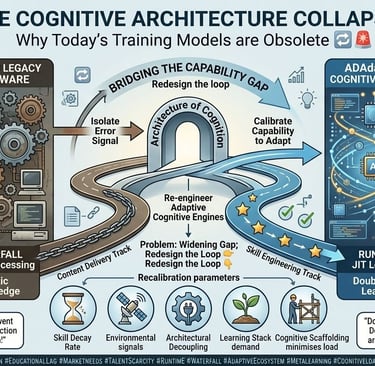
We are witnessing a structural breakdown in how professionals are developed. The issue isn't a lack of information; it’s an architectural failure in how we process it. When the modern market moves at the speed of a high-frequency "Runtime" signal, while our learning institutions and training models still respond with a slow, linear "Waterfall" batch-processing model, we face an aggressive Impedance Mismatch.

By Elad hershkovitz | Co Founder, EN SignalTouch
We are witnessing a structural breakdown in how professionals are developed. The issue isn't a lack of information; it’s an architectural failure in how we process it.
When the modern market moves at the speed of a high-frequency "Runtime" signal, while our learning institutions and training models still respond with a slow, linear "Waterfall" batch-processing model, we face an aggressive Impedance Mismatch.
To survive the exponential shifts documented in the World Economic Forum's Future of Jobs Report 2025/2026, we must completely re-engineer our cognitive frameworks.
Here are the 5 system parameters that we need to recalibrate immediately:
1. Managing Cognitive Entropy (The Skill Decay Rate) ⏳📉
The World Economic Forum warns that 39% of core professional skills could become obsolete by 2030. Knowledge's half-life is shrinking, increasing systemic chaos.
2. Embracing Leadership as a "Runtime Skill" 📐🛰️
You can't pre-train a modern leader or engineer in a sterile classroom. By 2026, operational expertise is a Runtime Skill used in high-entropy, noisy environments.
A professional’s true authority no longer comes from past credentials like degrees or GPA. It depends on their Sampling Rate—the speed at which they process error signals, perform JIT learning, and update mental models.
3. Closing the "Educational Lag" Through Decoupling 🔌⚙️
Graduates enter the workforce burdened by Cognitive Technical Debt due to slow curriculum accreditation, causing the Educational Lag.
The solution is Architectural Decoupling: separating core learning capacity from temporary content. Instead of fixed knowledge, we should assess a candidate's continuous Learning Rate.
4. Fueling Creativity via the Social-Emotional "Learning Stack" 🧬💡
Innovation isn't a mystical lightning strike. Genuine creativity results from an advanced social-emotional Learning Stack.
The World Economic Forum notes a surge in demand for analytical thinking, resilience, and flexibility. This requires Cognitive Empathy—the ability to understand an ecosystem's evolving needs and translate those into innovative, high-value solutions.
5. The Structure Paradox: SOPs as Cognitive Scaffolding 🚧👩💻
The myth that structure stifles innovation is false. In a complex market, complete freedom causes operational stress.
Structured procedures (SOPs) act as Cognitive Scaffolding, standardizing routines to reduce mental load. This allows the team to focus on high-stakes improvisation, Double Loop Learning, and experimentation.
The educational system is out of sync with industry. Static hardware can't handle real-time challenges.
We need to shift from teaching static content to building adaptive cognitive engines.
כל הזכויות שמורות ל-EN SignalTouch © 2026 | מדיניות פרטיות ומפרט תנאי שימוש.


למידה והכשרה
ארגונים וחברות
פלטפורמת הכשרה מקצועית שמחברת בין למידה, תרגול ומדידה לאנשים, לארגונים ולמנטורים.